You probably heard that interest rates are finally starting to tick downward or, more accurately, have ticked downward once recently, with the assumption that more cuts will follow by the end of the year. What do these adjustments mean to your Savings Goals?
Read below for what’s up with “The Fed”, and what you can expect to happen with your money!
What Happened:
“The Fed” (The Federal Reserve, who controls the nation’s Central Bank) lowered interest rates by “fifty points” or (0.5%) last week. Not only was this a bigger cut than had been predicted, this is first time we’ve seen interest rates fall in the last several years, after seeing some of the highest rates persist in decades.
The Fed uses this interest rate adjustment as a mechanism to combat inflation, with their goal of stabilizing it to around 2%. We are getting close to that goal, and therefore it’s expected that more interest rate cuts will come, by the end of this year.
How Does this Affect My Savings Accounts?
Up until this point, we’ve been enjoying, financially, the few benefits of higher inflation, specifically in regards to Savings Accounts.
High Yield Savings Accounts (HYSA) have long offered the best, most secure, accessible and low-risk option for keeping your cash on hand–and for the last few years, provided very “high” interest rates.The money you want to keep in these accounts is ideally used for your Emergency Fund: unexpected expenses and even short-term goals, like a wedding or a trip.
With The Fed lowering the prime interest rate, we will see interest rates in our Savings Accounts come down as well. For example, I’ve already received word, just since The Fed’s decision last week, that my HYSA at e-Trade will be coming down .25 percentage points—from 4.5% to 4.25%. This may not seem like a lot, but as the rates continue to fall, the impact as to how fast our savings are able to grow will be more evident.
Another time-tested strategy for saving our cash, as low risk as possible, has been using Certificates of Deposit (CD’s). Like HYSA’s these are old-school, trusted, FDIC insured options at major retail banks and credit unions. With interest rates falling so quickly on HYSA’s, your best bet might be to put your money into a CD.
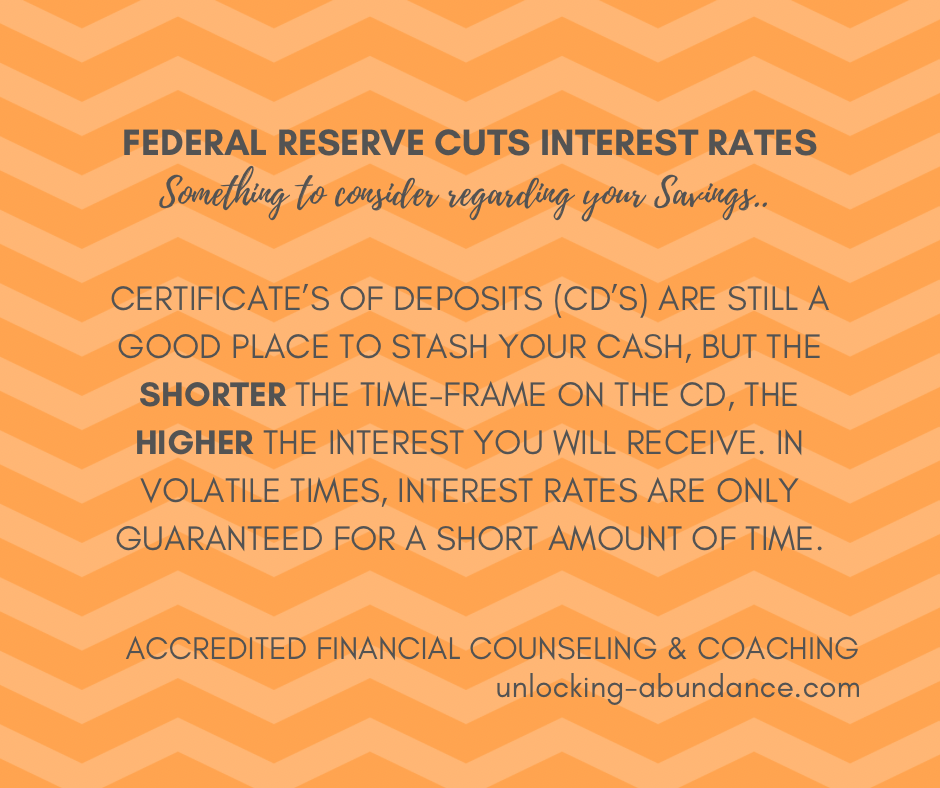
What’s worth noting right now, however, is that due to recent interest cuts, Shorter Term CD’s will be offering higher interest rates. This is counterintuitive to how CD’s have worked in the past: it used to be the longer you kept your money tied up in the CD, allowing the bank to make more money off of it, the higher interest rate you were offered. In volatile times like right now, this is no longer the case.
What Does All of This Mean?
When you put your money into a CD, be on the lookout for both percentage rates and terms of length. In the immediate time-frame, be wary of locking up your cash in a CD for longer than 6months. Right now, if gaining high interest on your investment is important to you, you want to restrict access to your money only in the short term–in case, predictably, interest rates continue to trend down.
Be extra diligent signing up with a CD, make sure it is FDIC insured and that you understand not only the time-length terms, but the action required by you at the time the CD “matures” (date you’re allowed to access your money). Some CD’s might stipulate that the funds will roll-over, automatically, unless you intercept. They could very-well roll-over into something much longer term and perhaps at lower interest.
Trusted Resource: CD Valet allows you to peruse all kinds of CD’s: by rate, online bank vs branch, term lengths, and more!
You can save your money, slowly and strategically–and it’s fun to watch it add up! How good would it feel to know you’re optimizing for the best interest rate?
 Unlocking Abundance