
March is Women’s History Month, and ICYMI, Equal Pay Day fell on March 12th this year. (That’s 2 days earlier than last year, so..yay, progress?) At this rate, though, it’s been calculated that equal pay might have a chance of being obtained by year 2124, or later. Ugh. Read below for the status of Equal Pay today, a reminder on the factors that drive this inequity, and a few organizations striving for progress!
In 1963, President Kennedy signed the Equal Pay Act (EPA) to protect against wage discrimination based on sex. The Wage Gap existed then, and it continues to exist.
Let’s touch base on what exactly Equal Pay Day is, how it relates to The Wage Gap, and where the math from the latest data puts women, today, in the quest to overcome these financial injustices.
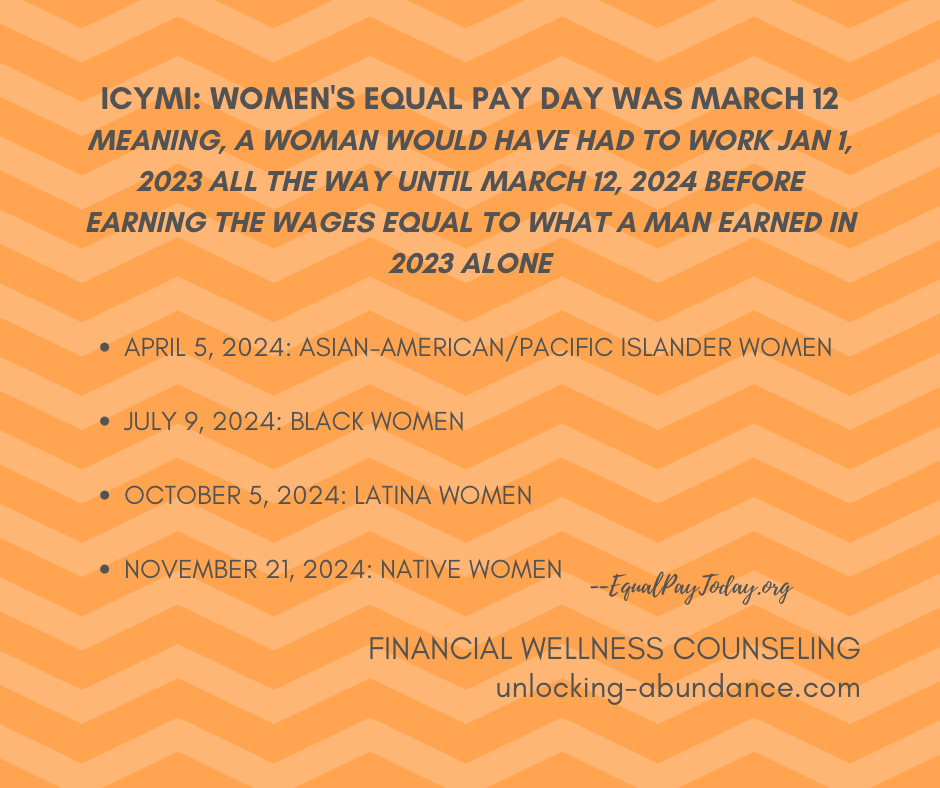
Equal Pay Day, which we’ve touched on before, measures how many more days a working woman would have to work in order to match annual wages of that of a man. It was calculated to be March 12 of this year. For example, if a man and a woman went into the workforce on Jan 1 2023, the woman would have to work until March 12 of the following year to earn the same as the man did in 2023.
That creates a “Wage Gap” and the math says that for every dollar a man made, a woman made about .84cents. (National Committee on Pay Equity and the Equal Pay Today Campaign)
The data is for working women in general. Equal Pay Day’s are available for BIPOC/Women of Color as well. The numbers get much worse. For 2024:
April 5th for Asian American/Pacific Islander Women
July 9th for Black Women
October 5th for Latina Women
November 21st for Native Women
What are the Factors Perpetuating the Wage Gap?
–Caregiving
A recent report showed that 59% of unpaid caregivers are women. Millions of women have stopped working due family care obligations. It’s long been known that when an elderly member of the family needs care, the expectation is that the daughter will/should do it. Men make up a minority of caregivers.
–Sexism in Pay Discrimination
A study of 265 major occupations found that the salary of men exceeded that of women in nearly all job types analyzed. There is further data to show that when a woman first enters the work-force, she is already starting at a lower salary vs her male peers simply because women are perceived to be not as “dependable” long term, or a “riskier” investment due to their biological ability to get pregnant, use leave/take temporary absence for pregnancy/birth/recovery, and therefore assumed to be less available.
–Cultural Expectations for Women’s Work
Lower paying jobs are culturally expected to be “women’s work” such as retail, care-giving, social work, child care, etc. Women are vastly underrepresented in higher paying roles that are thought to be filled by men such as construction, civic leadership roles, policing, etc.
–The “Motherhood Penalty”
Women are the ones who show up in greater majority when it comes to childcare/children’s needs. They leave work, use more personal days, or leave their jobs entirely when it comes to the needs of their children. They do this because they are expected to do this. We saw this in the greatest numbers, most recently, in the early days of Covid. In 2020, women, more than 4x the number of men, had dropped out of the workforce, due to family obligations. It’s been reported that mother’s earn .58cents for every dollar paid to fathers. (American Association of University Women)
Who is Moving the Needle on Equal Pay Right Now?
–Organizations Making a Difference
EqualPayToday.org is a project within Equal Rights Advocates. It is a nationwide campaign dedicated to changing policy and legislation in order to close the gender, race, and LGBTQ+ pay gap.
TheMomProject.com is a platform that makes it easier for mom’s to find jobs, and for companies to hire mom’s. They also push for their partnered companies to double down on mom-needed work benefits, offer scholarships, job training, resume skills and more!
AAUW.org American Association of University Women have been advocating for women/girls since 1881. They prioritize removing bias from education, fighting for fair pay, and advancing women in leadership.
If closing the Wage Gap is a priority for you, or a legacy you’d like to see left behind for those you care about, think about advocating for women’s equal pay, and supporting the organizations that do so. How cool would it be to be explaining to a young person what the Wage Gap was, but being able to follow up with, “oh yeah, we took care of that.”
 Unlocking Abundance