As Thanksgiving approaches, it’s that time of year where reflecting and being grateful for all that we have flows over. AND, what if we could go beyond what we have and conjure up what we want, using a new framework to stimulate the brain?
It’s been a while since we touched on Money Mindset as a topic. I strongly believe that what we think about money is responsible for how we manage it. By using affirmations, daily (or at least regularly!) there is scientific evidence that we can forge new connections in our brains, by forming new pathways of thought. Those new pathways ultimately change our beliefs, and thus our behavior and our outcomes.
The mind-body connection is truly that powerful!
Before we move on, a quick caveat about Money Mindset in the context of Financial Injustice. While we can use tools based on the phycological evaluations of humans as individuals and their behaviors in order to perhaps better our experiences, these methods do not account for systemic financial injustice. Large groups of people are impacted and held back financially by such causes as: The Gender Pay Gap, The Racial Wealth Gap, or any other systematic discriminatory practice such as “Redlining” or other types of Unjust Lending. These issues need to be prioritized and addressed publicly, and repeatedly, in order to keep moving the needle.
Now, back to the Mindset. We’ve talked about Gratitude as a tool to change your experience handling your money before. One of the reasons it works is that it keeps us in the present moment. Dwelling on the past can lead us straight to depression, regret, hopelessness and/or feeling stuck around making progress towards our money goals.
A new way: by stating, out loud, or writing down on paper, our future goals as if we’re reaching them now, we can lead ourselves down a path towards behaviors that falls more in line with them. Essentially, we express what we want as if we already have it, and our brain starts to believe it and fall in line with behaviors that mirror those beliefs.
Read on for more specifics on a framework explaining why this works, and give it a shot! Below is some paraphrasing of “The Model” by Brooke Castillo, 2021. It really shows that our thoughts are at the base of our behaviors and our outcomes.
“The Model” (paraphrased here):
A Circumstance occurs.
We come up with a Thought about that circumstance.
The thought gives us a certain Feeling.
The Feeling leads to our Behavior.
The behavior leads to the actions we take and Outcomes we experience.
So, if we work backwards, the situations we find ourselves in financially could be a direct result of our initial thoughts and how we feel about those thoughts.
In the context of money, this might look like:
Having more debt than you would like (Circumstance).
Believing you’ll never be able to pay it off (Thought).
(Feeling) Shame, guilt, overwhelm about what to do.
Ignoring the debt all-together, making late, or minimum-only payments (Behavior).
Staying in a cycle of never-ending debt (Outcome).
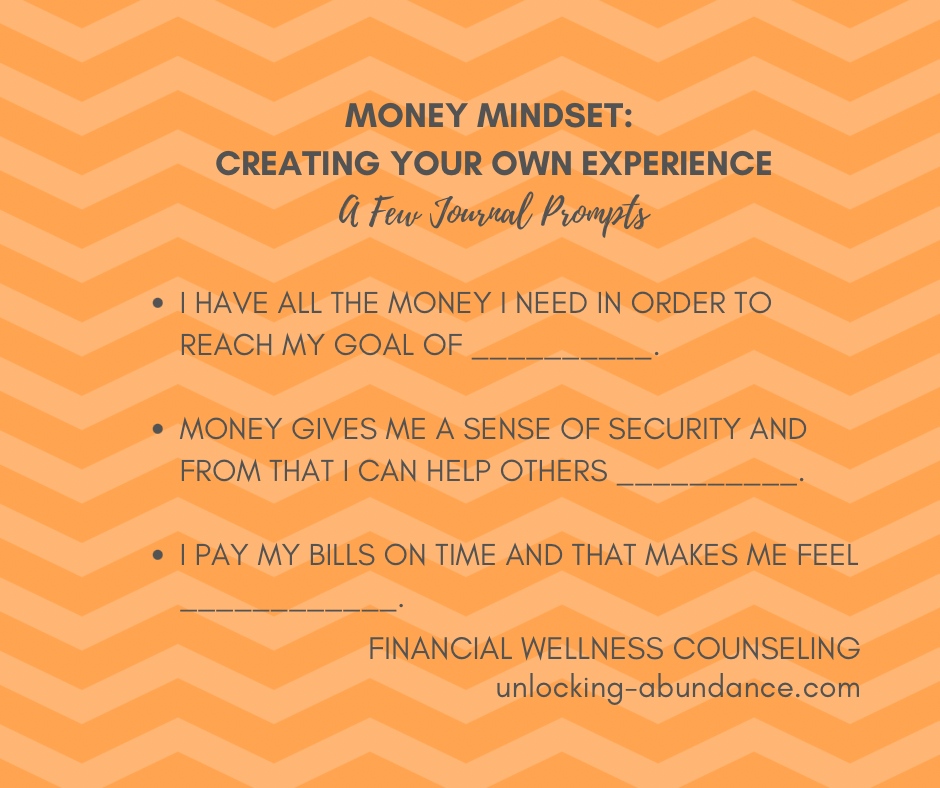
By going back to our thoughts, we might be able to create a new scenario for our outcomes. There is evidence we can create new brain pathways, simply by telling ourselves affirmations, in the present tense, and creating new thoughts. Use positive I-statements, in the present tense, that reflect your goals as if you’ve already achieved them. Keep it simple.
A few examples:
“I have all the money I need to pay my bills and I pay them on time.”
“I make enough money to meet my needs and my wants.”
“I no longer worry about money; it is a tool that I can use to meet my goals.”
By tweaking the process, at the thought level, perhaps we could change the outcomes.
That could look something like this:
Having more debt than you would like (Circumstance).
Believing you’re worth the effort and will be able to break the debt cycle (Thought).
(Feeling) Empowered, motivated to try something new, and in control.
Asking for help or getting on a payment plan (Behavior).
Being on your way to getting out of debt! (Outcome).
If you can get in the habit of telling yourself your new beliefs, even if they sound false at first, you may experience a change in behavior and outcome as result.
What do you have to lose?
 Unlocking Abundance