This one goes out to all those couples who are engaged! Congratulations! Now, to pre-nup..or not to pre-nup?
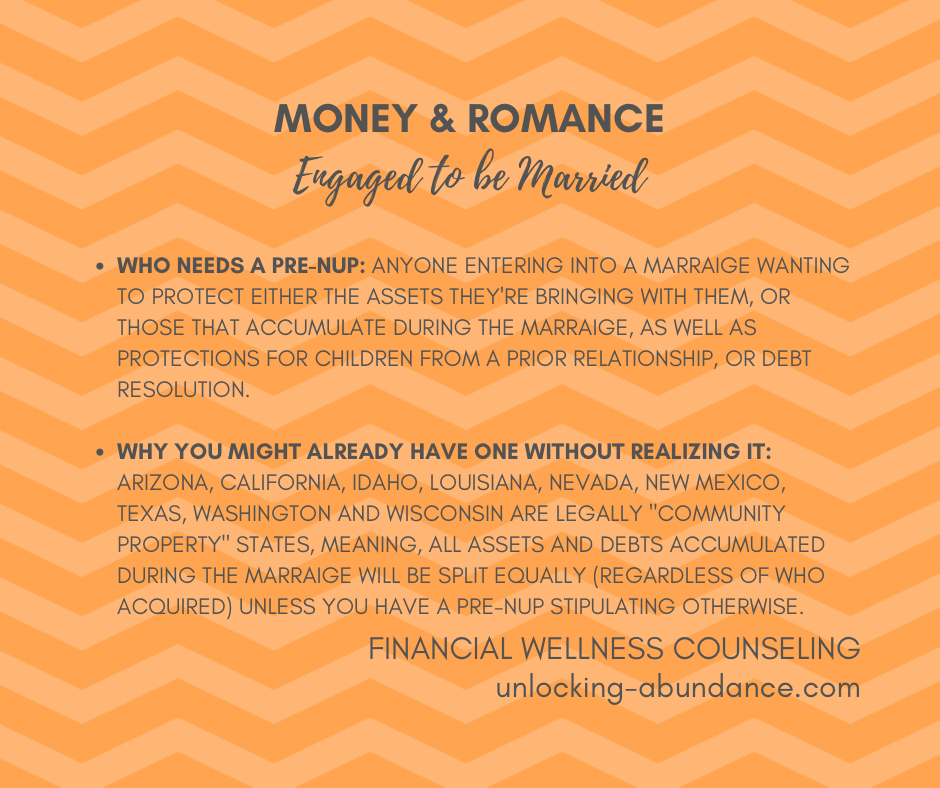
And..what if I told you, if you live in a handful of states with “Community Property” laws (AZ, CA, ID, LA, NV, NM, TX, WA, WI), a pre-nuptial agreement is your only way to decide what YOU want to happen with your assets vs. what the State decides for you, should the relationship end in divorce.
A few Stats:
–The current divorce rate across the US for first marriages is 40-50%.
–The divorce rate for 2nd marriages upticks to 60-67%.
Good news! As people are getting married later in life, the divorce rate is actually declining (settling closer to 40%). For those aged 65+, however, divorce rates have tripled since the 1990’s (when hardly anyone that age was getting divorced!). When older people get divorced, and no defined agreement (like a pre-nup) is in place, women statistically get the worse end of the deal (financially) and they live longer, so they need the most money!
Prenuptial agreements have been gaining in popularity, perhaps because people are bringing more assets to the relationship, and more education about how to protect themselves going in.
What is a Pre-Nuptial Agreement?
A legal document that essentially says what each person is coming into the marriage with, asset-wise (Cash, Retirement Accounts, Investments, Businesses, Real Estate, Children, etc.), and a detailed plan of how these assets will be protected and/or split if the relationship ends. It also includes each person’s current debts and how those will be addressed. (This part can be really helpful for determining things like student loan debt!)
Who Needs a Pre-Nup?
These documents are especially important for those coming in with either assets, businesses, or children from a previous partnership so that those assets and/or children can have their best interests legally stated by the couple, rather than left to state law.
What Makes a Pre-Nup Valid?
–A written legal document, signed (voluntarily), with witnesses (required in certain states) that meet the deadline required for signing (deadlines are also required in certain states, typically a reasonable amount of time before the wedding date).
–Both parties should have their own attorney (required in certain states).
–Full disclosure of assets by both parties; documents can be found invalid if assets are discovered later that weren’t previously disclosed.
–A balanced agreement, where both parties gain from the document.
What if I Do Not Get a Pre-nup?
Although gaining in popularity over time, a lot of couples do not have pre-nups–Jeff Bezos and his wife of 26 years, for example, did not have pre-nup! Since they live in what is known as the “Community Property” state of WA (see other Community Property states listed above) the state’s own laws dictated the splitting of assets the couple had accumulated over that time, regardless of what they would have preferred.
In short (not an attorney) in a “Community Property” state, each person in the partnership is legally entitled to half of the assets that were accumulated during the course of the marriage as well as legally liable for any debts accumulated, including those they did not personally obtain. Meaning, someone has a right to half of your assets, business, etc. and you may be on the hook for someone else’s debts and obligations.
What if I Didn’t Get a Pre-Nup and Now I’m Married and I Think I might Need One?
You may have an opportunity for a Post-nuptial Agreement. These give already married couples a do-over if they missed the window of opportunity for a pre-nup. See a divorce attorney for advise.
Bottom line: use this information to allow yourself to recognize that a) marriage is, at the end of the day, a contractual agreement between two people and their financial lives and b) you may or may not end up in the divorce rate. None of us know what will happen in the decades we sign on to these really long relationships together; we only have the statistics to look back on and experience to learn from. A pre-nup is simply one more form of insurance that goes along with the many risks of life.
And, although, not especially sexy or rom-com worthy, we can look at this as an opportunity to plan together for financial security on the front side, rather than figure it out during a time of stress–and if you never have to use it, hurray!
Especially important: if you have any insecurities about money in your relationship before getting married, this document can be helpful in order to get all of this sorted and out in the open so you can focus on your marriage financially-worry free!
Now, how good would that feel?
 Unlocking Abundance