
We’ve been hearing an awful lot about the “debt ceiling” lately. Read below for what it is, the history, and the consequences of what may or may not happen next.
What is the Debt Ceiling?
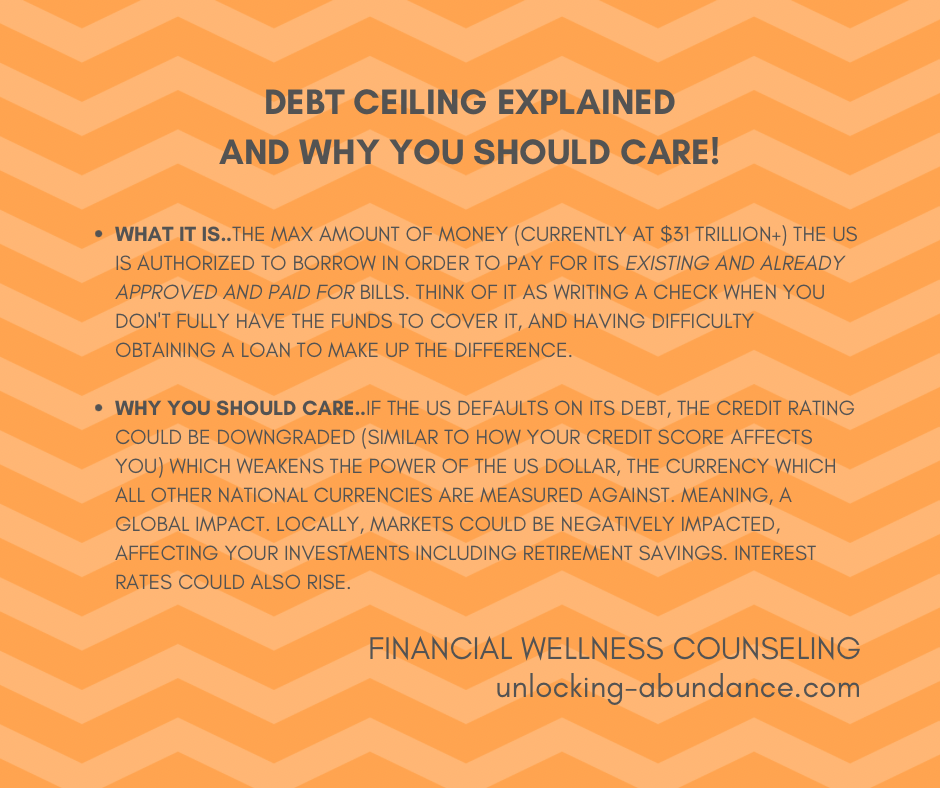
The debt ceiling is the total amount of money the US is authorized to borrow in order to meet its existing, and paid for, financial obligations. These obligations include payouts to individuals (Social Security, Medicare, and tax refunds) Defense Spending (military salaries) Government Basic Expenses (Federal worker’s salaries and benefits, and basic operating expenses) as well as money owed to the States.
The way the government operates, financially, is by voting to spend and then borrowing the funds within a distinct period of time. It would be akin to writing a check you cannot fully fund and having to ask for a loan in order to cover the balance due. It’s not an approach we would want to use for our personal finances, but it’s the way government spending works.
Since we reached our current ceiling of $31+Trillion in January, we’re essentially using extraordinary measures (pulling from a number of sources) to pay for everything between then and June, when we’re expected to exhaust all funds. Exhaustion of funds means there is no longer money available to pay the government to stay open for business.
How many times has this need to increase the debt ceiling been an issue?
The debt ceiling began in 1917, as a way to raise additional funds in order to pay for WWI. Throughout the 1940’s, the debt ceiling was raised several times.
In 1979, a congressman in Missouri put forth a rule which automatically raised the debt ceiling at each budget approval, so it was just a part of the process. That continued until 1994 when the rule was repealed as a tactic to prohibit the administration at the time from their desired spending. This tactic has become a common stand-off event, resulting in many temporary government shutdowns.
Overall, we’ve experienced as many as 21 different shutdowns, as the result of not being able to come to an agreement to raise the ceiling.
What’s next, and how will this affect me?
Since we’ve been here many times before, it’s most advantages for all parties to come to a deal by early June, in order to avoid a government shutdown and the impactful fall-out.
If they don’t come to a deal, however, a few different paths could be taken. Leadership could continue to gather funds from extraordinary sources, extending the deadline beyond June. President Biden could agree to budget cuts once all of those extraordinary resources are exhausted. (Note: cutting spending does nothing for our situation now, since the bills are already approved, but it could keep us from hitting a future debt ceiling by curbing spending.)
If there is no deal reached at all and all funds are exhausted, the US will default on its debt and we’ll likely see a government shutdown impacting salaries, the markets, (historically, only temporarily) investments and retirement savings included, and a decrease in the value of the dollar which affects all national economies since their value is determined in comparison to how the US is doing. Interest rates would also be likely to rise higher than they already are on everything from loans to credit cards.
If that situation persists for an extended period of time, and a resolution is not met, the consequences are unknown but considered to be dire as we would be in unchartered territory.
 Unlocking Abundance