A quick follow-up to your tax situation this year. How did you make out? Did you get a big refund, did you owe..break even, or somewhat close to it?
Read below for a few considerations that fit your situation. Again, not tax advice. Ever.
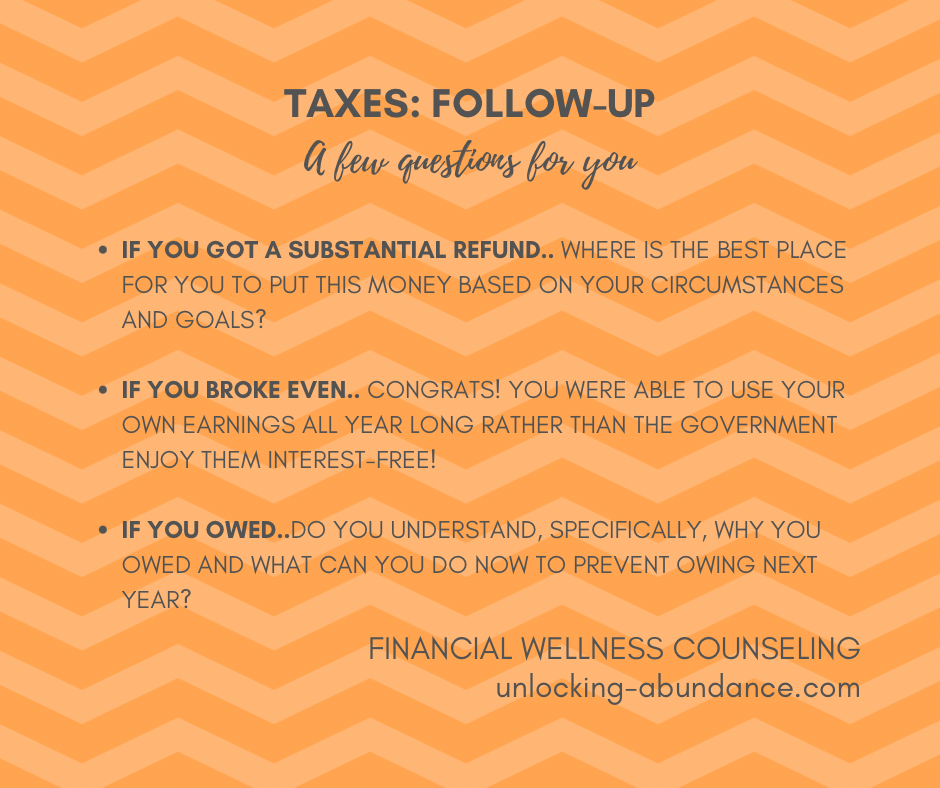
If you got a substantial refund..
Do you usually get a big refund? Are you ok with living on less all year long? If you’d rather use your own money all year rather than receive a refund check once a year, check in with your payroll service about reviewing your current withholdings.
If, however, you get a beefy check back every year, and you’re ok with that, but you’re not quite sure what to do with it to make the biggest impact on your wealth-building, consider the following:
–Evaluate your personal financial goals and circumstances.
–How is your Emergency Fund? Could you sustain yourself if you didn’t get a paycheck for 3 months?
–How are you feeling about saving for retirement? If you have a situation where you’re eligible to capture any matching dollars in a company-sponsored 401(k), think about turning there next—it’s free money, offered to future-you.
–How are your debts? With today’s outrageous national interest rates on credit cards hovering around 20-24% (that’s compared to 16% just a year ago) debt can really deter any opportunity to build wealth because much of your payment is just covering the interest. Shoot to pay down any debts where interest rates exceed 7%.
–If you’re feeling pretty flush, and you’d like to put your refund into savings for a specific goal, think about using a High Yield Savings Account or a Certificate of Deposit (CD). Both are earning highest interest-rates in decades, and both have their pro’s and con’s. When increasing your savings, identifying exactly what the money is for, and then treating yourself when you reach a set milestone is one way to stay on target to reaching those goals.
If you broke even..
This is a financially balanced place to be. You’re using your own money all year long, rather than the government hanging onto it for you, interest-free to them. If you’re used to breaking even, and not much has changed this year, feel free to congratulate yourself and stay the course.
If you have some big life-changes this year (new job/change in income, have a child, get married, sell any assets, etc.) read below for how to prepare for a potentially higher tax bill next year.
If you owed..
–Employees: Revisit your W-4 (the form you filled out at hiring) especially if you haven’t updated it in a while. This is the document that specifies how much is pulled from your paychecks and is especially important to update if you experienced any of those life-changes such as marriage or having new dependent. You can also request that more be taken out of your paycheck all year long, so that you don’t owe as much at tax time next year. You can also visit with HR on how you might lower your tax burden by participating in company benefits that are tax-deductible.
–Self-Employed or Side-Hustler’s: Understand your income tax bracket as well as Self-Employment Tax that you may be responsible for. When you work for yourself, you can end up in the double whammy tax situation of owing tax as both employer and employee.
–Identify exactly why you owed. Did you incur any penalties that can be avoided next year? Some business owners are required to make Estimated Tax Payments to the IRS quarterly throughout the year, thus the bill at tax time isn’t as hefty and penalties are avoided.
–One rule of thumb is to set-aside 10-30% of your income, each time you are paid, for tax purposes. It is also worth paying a professional to prepare your taxes for you, as the rules change constantly and most of us are not tax experts.
Bottom line: If tax time makes you nervous, plan ahead. Set aside the funds now on a regular basis (as in right now, because we’re in Tax Year 2023!) and the tax-filer you of 2024 will thank you!
 Unlocking Abundance