
April is Financial Literacy Month!
We touched recently on the definitions of Stocks, Bonds, ETF’s and Mutual Funds. Let’s expand our knowledge with some more investing terminology!
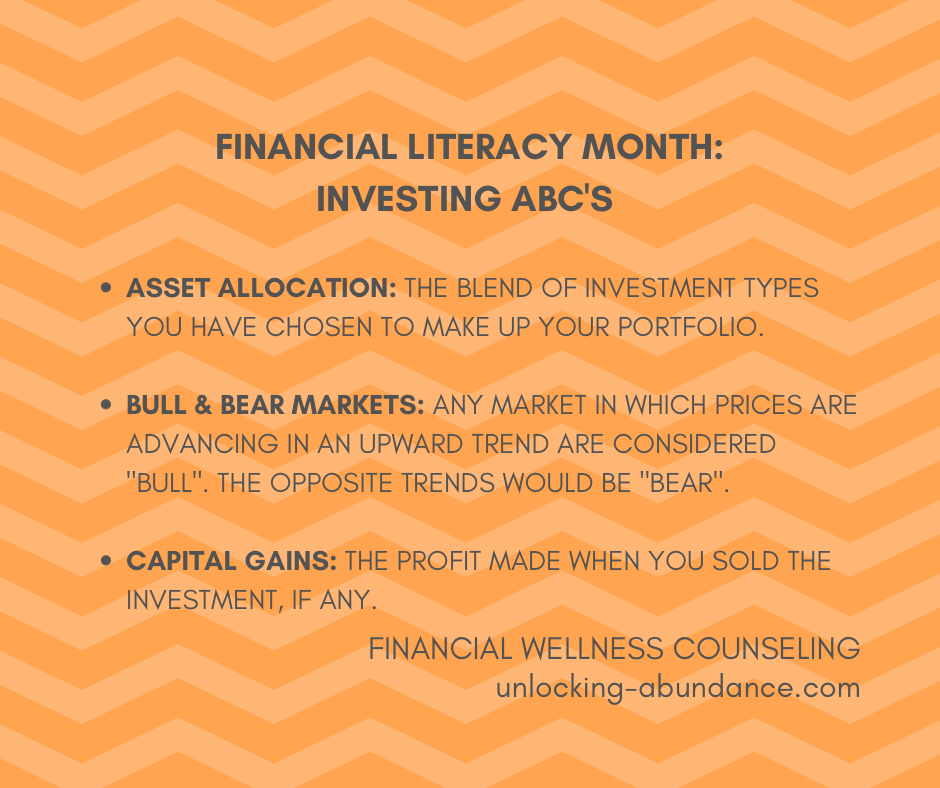
A: Asset Allocation: The different investment types you have chosen to make up your portfolio (see “P” for Portfolio below).
B: Bull/Bear Markets: Any market in which prices are advancing in an upward trend is considered “bull”. The opposite trends would be “bear”.
C: Capital Gains: The profit made when you sold the investment, if any.
D: Dow Jones Industrial Average: Known as “The Dow”. One of the 3 main trackers of how the stock market is performing. Tracks 30 major companies of the most familiar household names.
E: Environmental, Social, Governance (ESG) Investing: Impact-investing; companies that are prioritizing environmental or social concerns as well as their profitability.
F: The Fed (Federal Reserve Board): The governing board of the Federal Reserve System, it regulates the nation’s money supply.
G: Growth Stocks: Small or new companies who’s earnings are expected to grow faster than their competitors in the same sector.
H: Hedge Fund: A group of private investors whose money is managed professionally by fund managers.
I: Index: Tracking the performance of many investable companies at once. All tracked investments in that group make up the “index”.
J: Junk Bonds: A bond with a lower credit rating.
K: 401(k): A company-sponsored retirement account that employees may contribute to.
L: Loads (Back-end, Front-end, and No-load): Charging structures for Mutual Funds. Back-end you pay additional charges when you sell, Front-end you pay additional charges when you buy, and No-Load have none of these types of additional charges.
M: Maturity Date: The date the bond you invested in is paid up from whoever created it, or in Certificates of Deposit (CD’s) the date the CD “matures” and you can access your money, plus any interest gained.
N: Nasdaq: (National Association of Securities Dealers Automated Quotations system). One of 3 main trackers of how the market is performing. Tracks over 3,000 (mostly tech-related) companies.
O: Operating Activities: One of the metrics investors use to evaluate how a company might perform, when considering whether to invest. These are the daily operations of running the business itself including administration and producing/selling its product.
P: Portfolio: The entire collection of your investments, managed as a whole.
R: Recession: A downturn in the economy’s production. Usually identified by two consecutive quarters of decline in GDP (Gross Domestic Product).
S: S&P 500 (Standard & Poor’s 500): One of 3 main trackers of how the stock market is performing. Tracks 500 of the largest companies in the US across all types.
T: Time Horizon: The amount of time before you expect to need your money back on that particular investment.
U: US Treasury Bonds vs. Bills vs. Notes: U.S. government-backed bonds you can invest in that differ in time horizons, yields and risk.
V: Volatility: The amount of increase and decrease in value that particular investment experiences.
W: Wall Street: A street name in New York City. The term “Wall Street” is used broadly as a location where companies are traded publicly.
Y: Yield: The percentage rate of return you earn on that particular investment.
Can anyone come up with a “Q”, “X”, or “Z”??
 Unlocking Abundance