As 2022 comes to a close, a few buzzwords come to mind..one of them being INFLATION.
Let’s take a moment to get a primer on Inflation, learn how to calculate YOUR Personal Inflation Rate, and see how you might actually benefit financially.
Inflation: what is it?
If you’re like me (not an advanced economist) you probably have a vague idea of what inflation is.
Quite literally, when the cost of something was at one time lower than it is now, say that gallon of milk was X and now it’s (3x)X, that’s inflation.
What causes inflation?
Well again, not an esteemed economist here but it can be broken down into disruptions of supply and demand in our fragile financial eco-system.
Throw in a once-in-a-century pandemic and things get way off balance!
Meanwhile, the rest of us are feeling it since inflation is higher than it’s ever been in the last 40 years!
At the time of this writing, inflation is hovering around 7.1%, whereas we used to coast at a cool 2-3% annually.
Inflation: how does it impact me personally?
If inflation causes gas prices to soar, and you don’t drive a car, it’s not going to affect you much.
Where are YOU hit hardest?
Take a moment to calculate your “Personal Inflation Rate”.
Look at your Fixed Expenses, or monthly NEEDS, such as: groceries, mortgage/rent, transportation, phone bill etc. from your bank statement a year ago.
Compare that with what you’re spending now in those same categories.
To calculate your Personal Inflation Rate, subtract what you spent then from what you spend now and divide the remainder by what you spent then.
Maths! Example: If you spent $1000/Month on necessities a year ago and now you spend $1250/Month, $1250 – $1000 = $250 difference, and $250/$1000 =.25
Your Personal Inflation Rate would be 25%.
Once identify your Personal Inflation Rate, you have another data point of just how much (more expensive) your life costs compared to what it used to a short time ago.
Knowledge is power! Use this info when making financial decisions like taking on more debt or considering a new purchase.
Inflation: How can I benefit?
As interest rates continue to rise on everything from credit cards to loans, they also go up on our Savings accounts!
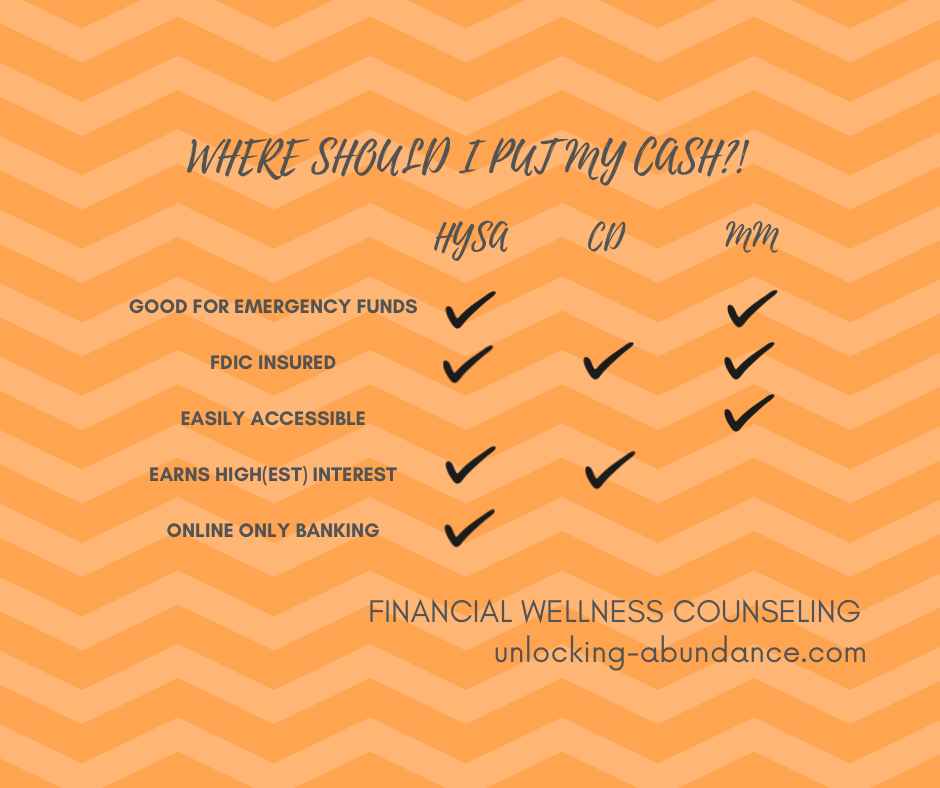
Three of the most common Savings vehicles that may earn you higher interest right now are: Money Market Accounts, High Yield Savings Accounts (HYSA), and Certificates of Deposit (CD’s).
Each come with their own pros and cons.
Money Market Account:
These accounts have the same FDIC insured advantages as your basic savings account, and may offer a slightly higher interest rate.
However, they usually require a minimum balance and may come with start-up fees.
Think of these as a checking account (many of them allow you to write checks) that actually gains a little interest.
High Yield Savings Account (HYSA) (My personal fave):Institutions offering the highest interest rates on these types of accounts usually only exist online. Although they are FDIC insured, you have to get used to online banking and the time to actually transfer the money from their account to your checking account may be delayed slightly due to time of day/weekends.If you’re ok with this slight delay, this is a great place to stash your cash to grow during inflation because these accounts provide a whopping of interest, when it comes to Savings accounts.At the time of this writing my main brick and mortar big bank savings account is offering a APY (annual percentage yield) of 0.01% while my online-only HYSA is offering 3.25%. Maths–again! If I was to put $1000 into a HYSA and never add to it, in a year I would earn $32.50 in interest, whereas if the same $1000 sat in my basic savings for a year it would earn just 10cents!Use this calculator to see how fast your savings can grow at different interest rates: https://www.investor.gov/financial-tools-calculators/calculators/compound-interest-calculator. It really does make a difference!
Certificates of Deposit (CD’s):
Unlike the compact discs of our youth, financial CD’s are actually experiencing a revitalization as a place to put your cash!
With interest rates finally on the rise again (and some major stock market-volatility lately) CD’s are another a safe place (again, FDIC Insured) to store some cash that can actually gain some decent interest rates!
The con with these is that your money is tied up (not-accessible!) for a determined length of time know as “the term”.
You know the term going in, and you cannot touch that money until then (or perhaps without penalty—read the fine print!).
It can be a matter of months, to a matter of years.
Typically, the longer the term, the better the interest rates.
Thus, this is NOT a good place for your Emergency Fund; you want that to be accessible.
There are usually initial minimum deposit amounts required.
Tip: Online Only banks may have better deals on CD’s; the average one-year C.D. at online banks was 4.1% at the start of December, up from just 0.5% at the beginning of this year.
Take a moment to think about how inflation impacts you, and the tools you might use to fight back!
 Unlocking Abundance