
As Open Enrollment is here, or approaching, for many of us let’s talk about interpreting medical bills!
Read below for how to address a medical bill, your rights for appeal, financial aid available, and what to do if you are sent to collections.
Step One–Open your Medical Bills and Check for Errors:
As tempting as they are to ignore, the charges billed are not going away, and the burden is on you to address them.
On the up side, medical debt has the potential to cost you less than other types of debt, since it typically does not accrue interest.
Plus, here in WA State we have the right to an appeals process, may be able to negotiate the cost down, and eligibility for financial aid has recently been expanded.
Finally, also in our favor, the three major credit bureaus recently announced that most settled medical debt is no longer allowed to affect credit scores. For more on this, see the “ICYMI: Medical Debt is Leaving Credit Reports” blog post from 7/23/22.
It’s been shown that as many as 80% (!!!) of medical bills contain errors, so make sure you check the following on your own bill:
What it says you owe.
What each charge is for.
What your insurance paid.
Any mistakes.
Contact info should you have any questions, including who to contact for the Appeals Process.
Step Two–If you believe something should have been covered that wasn’t: (otherwise skip to Step Three)
Familiarize yourself with your Provider’s Appeals Process.
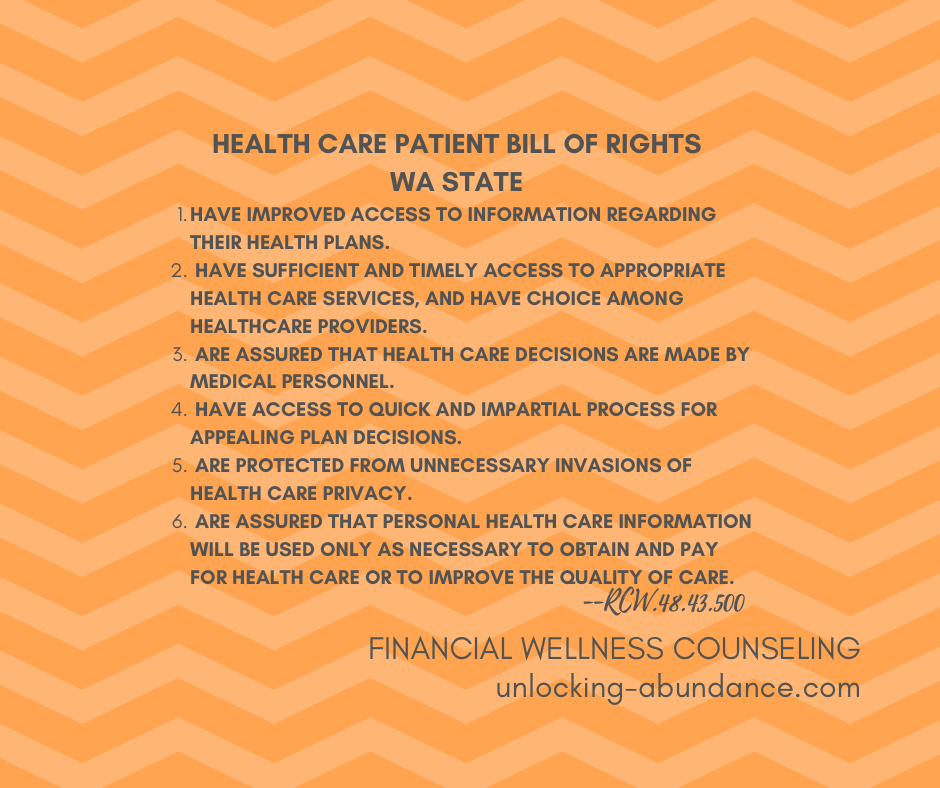
Here in WA State, you are entitled to a “quick and impartial process” when it comes to appeals.
That means timely; a neutral third party can step in if you request it.
The process usually includes you initiating contact, and then writing a follow-up letter/filling out a form explaining why you believe the charge should be covered that wasn’t.
You will be contacted, within a set matter of days, with the appeal decision. You are not expected to pay the bill while in the appeals process.
If you are denied–do not give up! There is usually a chance to appeal the decision.
Step Three–If you can’t afford the balance due:
See if you are eligible for Charity Care.
Eligibility requirements for the Charity Care Law in WA State were recently expanded to include many more people! For more on this, see the “Charity Care Law” blog post from 9/21/22.
You’re allowed to apply for Charity Care at any time, even if you are in collections.
You can also attempt to negotiate the amount due. Contact your provider and see if there is any opening for negotiating to a lesser amount. Do your research; what should the procedure have cost?
To see general medical costs in WA State, visit https://www.hca.wa.gov/billers-providers-partners/prior-authorization-claims-and-billing/provider-billing-guides-and-fee-schedules.
Your provider might also agree to a discount if you agree to a payment plan and put your installments on automatic payments.
FYI–If you are contacted by collections for Medical Debt:
If the provider can’t or won’t negotiate, then ask the bill collector if you can settle the bill for a lesser amount.
You have the right to request an itemized statement that gives you all of these:
The name and address of the medical creditor.
The dates of service.
The services the provider claims it provided you.
The amount of principal owed on the debt,
any adjustment to the bill, the amount of any payments received from you or anyone else.
Any interest or fees.
If you were found eligible for Charity Care and if Charity Care payments were applied to the debt.
Next Steps: One of the best ways to prepare for unexpected medical costs is to build up your Emergency Fund. The rule of thumb is to have AT LEAST 3 months’ worth of your basic monthly “Needs” for non-medical related unexpected expenses, plus you can add to the fund to account for medical costs. For example, you may want to save 3+ months of your “Needs”, plus the amount of your annual deductible.
 Unlocking Abundance