
Since we’ve had Open Enrollment on the mind, let’s take a deeper dive into the Health Savings Account!
Specifically, how we can use it as a “look back” in order to reimburse ourselves for old medical expenses, and also as a “look forward” as a tool in order to build wealth for retirement! If you’re an entrepreneur, or responsible for your own retirement savings, you’ll want to read below on how you might use the HSA to your advantage!
Looking Back/Reimbursing Ourselves for Old Medical Expenses:
Question: Did I have the HSA before I incurred these expenses?
If the answer is “yes” you may reimburse yourself, as long as you hold the receipts/have proof of what you paid and check that it was an “eligible medical expense”.
If the answer is “no”, you may not use the HSA to reimburse yourself.
Action: You will take the money out of the HSA and transfer it to yourself. At tax time, you will be issued a 1099-SA form for the “HSA Distribution” and you will claim it on your tax return.
If the money was used for an “eligible medical expense” you will not be taxed on the money.
Tip: You don’t have to reimburse yourself for medical expenses by a specific date. This means that if you pay for eligible medical expenses out-of-pocket, you can wait 10, 20 years or longer to pay yourself back!
Alternatively, let’s say you used to work for an employer where you (or they) added money to a HSA for you. Then you got a new job (or switched plans), and you signed up for health insurance that didn’t have a high deductible. What happens to your old HSA?
The HSA is yours forever! You can continue to use it for medical expenses, but you cannot fund it if you do not meet the eligibility requirements, including having the high deductible health insurance plan (currently at $1400/Single, $2800/Family).
Looking Forward/Using the HSA as a Tool to Build Retirement Savings:
(Disclaimer: not investment advice; just how this tool works!)
Question: Can I pay for my medical expenses out of pocket, for the most part?
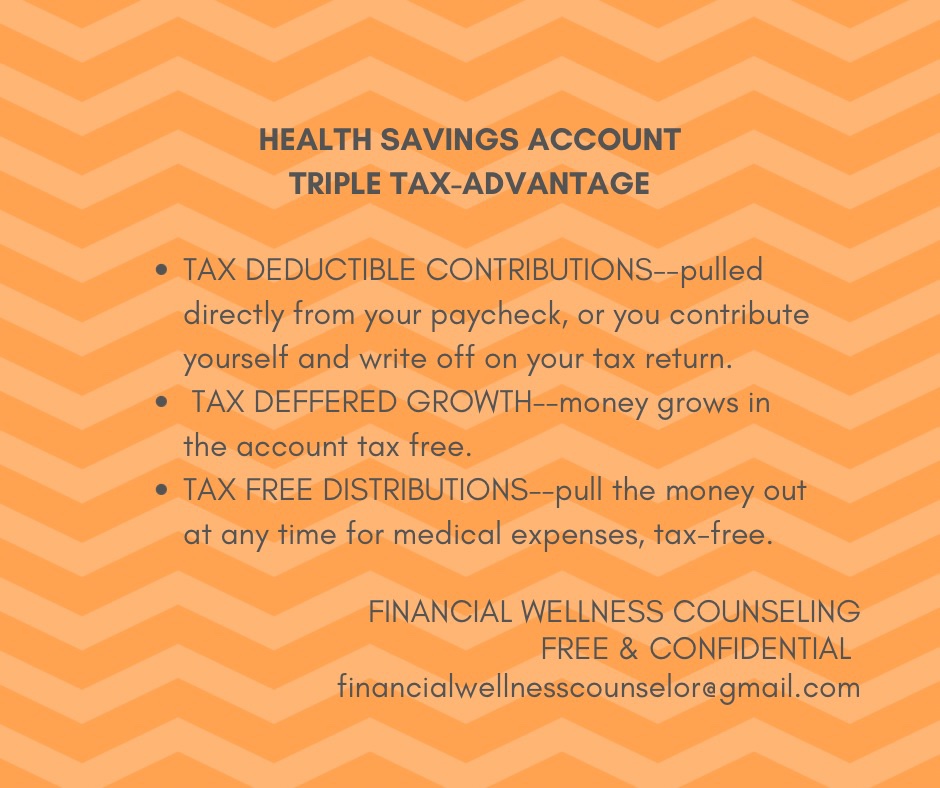
If the answer is “yes” you could be a good candidate to use the HSA as a place to grow your retirement savings, tax-free, similar to a 401(k). If you want to use your HSA as a savings vehicle, you won’t use it to pay for ongoing health care expenses — you’ll leave it alone and let it grow.
Action: Sign up for an HSA.
Learn more about your HSA options through your employer or open an account yourself (I use Fidelity; not an endorsement!). You can search for an HSA through a bank, broker, credit union or insurance company.
Check into the investment options at the HSA you are interested in.
You can put your HSA money into more than just a savings account. Putting your money into investments with the potential for higher returns is where the magic happens!
For a calculator in order to see how your money can grow visit:https://www.nerdwallet.com/article/investing/investment-calculator
Tip: Know what’s going on in your accounts. You must monitor your contributions to ensure they do not exceed the annual contribution limit (currently $3650/Individual, $7300/Family).
You will get dinged in you contribute too much! Have HSA funds in another account from a previous job? You can transfer funds from or roll it over to another HSA as well. When you consolidate your accounts, monitor your contributions to ensure they do not exceed the limits!
Learn about the fees associated with opening a HSA: I personally use Fidelity, they don’t charge me investment transaction fees, neither is there a minimum to start investing, I believe. (Not an endorsement!)
However, some HSA providers typically charge the following fees, which can eat into your profits: Administrative fees, Investment fees, Transaction fees. Be on the lookout!
Then, let the money grow until retirement! When you withdraw your money in retirement, prior to turning 65, you pay income tax plus a 20% penalty if you don’t use your money to pay for qualified medical expenses. Once you turn 65, that 20% penalty no longer applies, so you can withdraw penalty-free for nonqualified expenses. However, you do still have to pay the income tax on the money, just like you would a 401(k).
Note that once you enroll in Medicare, you can no longer fund your HSA.
 Unlocking Abundance